
Introduction
Every year after the Super Bowl ends, one moment quietly steals attention the Gatorade shower. Fans don’t just celebrate the winning team; they try to spot the color of the drink dumped on the coach.
It may look like a simple celebration, but over time, it has turned into a fan obsession, betting market, and statistical curiosity.
If you’ve ever wondered:
- Which Gatorade color appears most?
- Whether there’s any pattern behind it
- Or if it can actually be predicted
This guide breaks down the complete Super Bowl Gatorade color history, along with trends, hidden patterns, and insights most articles miss.
What Is the Gatorade Shower Tradition?
The tradition started in the mid-1980s with the New York Giants when players dumped a cooler on head coach Bill Parcells after big wins.
What began as a spontaneous locker-room joke quickly became a symbol of victory in the NFL.
By the time the Giants won the Super Bowl in 1987, the Gatorade shower had become a nationally recognized celebration and today, it’s one of the most anticipated post-game moments.
Complete Super Bowl Gatorade Color History (2001–2026)
Here’s a full breakdown of Gatorade colors from the last 25 Super Bowls:
| Year | Winner | Gatorade Color |
|---|---|---|
| 2026 | Seattle Seahawks | Yellow |
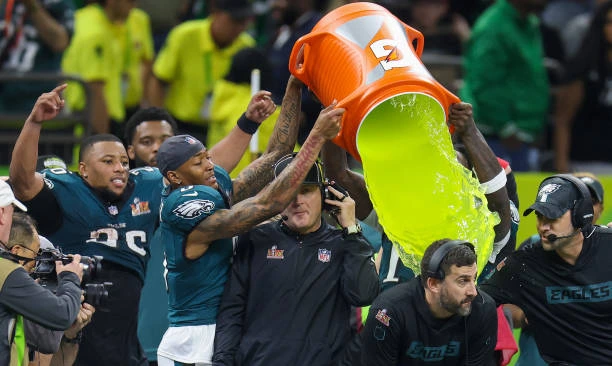
| 2025 | Eagles | Yellow |
| 2024 | Kansas City Chiefs | Purple |
| 2023 | Kansas City Chiefs | Purple |
| 2022 | Rams | Blue |
| 2021 | Buccaneers | Blue |
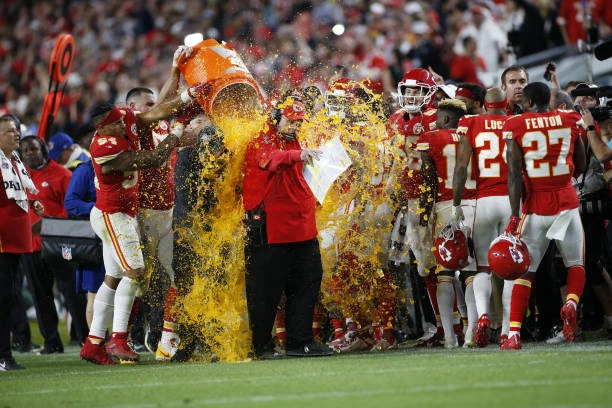
| 2020 | Kansas City Chiefs | Orange |
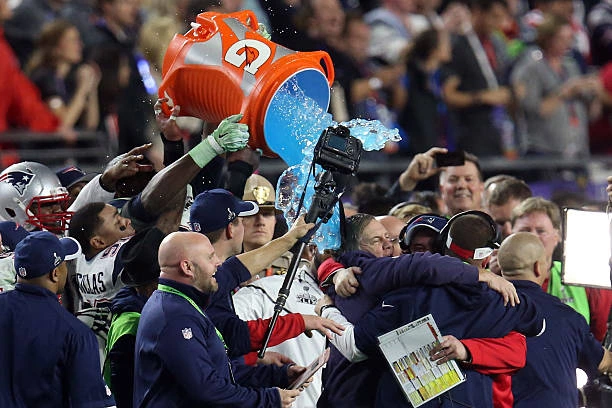
| 2019 | New England Patriots | Blue |
| 2018 | Eagles | Yellow |
| 2017 | New England Patriots | None |
| 2016 | Broncos | Orange |
| 2015 | New England Patriots | Blue |
| 2014 | Seattle Seahawks | Orange |
| 2013 | Ravens | None |
| 2012 | Giants | Purple |
| 2011 | Packers | Orange |
| 2010 | Saints | Orange |
| 2009 | Steelers | Yellow |
| 2008 | Giants | Clear |
| 2007 | Colts | Clear |
| 2006 | Steelers | Clear |
| 2005 | New England Patriots | Clear |
| 2004 | New England Patriots | None |
| 2003 | Buccaneers | Purple |
| 2002 | New England Patriots | None |
| 2001 | Ravens | Yellow |
Gatorade Color Trends
Looking at raw numbers is easy, but understanding why these patterns exist is what actually gives this topic depth. When you go beyond the surface, it becomes clear that Gatorade color outcomes are shaped more by real game situations than by any statistical pattern.
Why Yellow and Orange Dominate
Yellow and orange have appeared more frequently than any other colors, and this is largely due to how NFL sidelines are managed. These flavors are considered standard hydration options, which means teams usually stock them in higher quantities compared to other colors.
During post-game celebrations, players are not making calculated decisions. They react in the moment and grab whatever cooler is closest. Since yellow and orange are more commonly available and easier to access, they naturally end up being used more often. Their dominance is therefore a result of availability rather than prediction.
Why Red Has Never Appeared
One of the most surprising details in Super Bowl history is that red or pink Gatorade has never been used. At first, this seems unusual, but when you look at sideline practices, it starts to make sense.
Red is not typically a primary flavor stocked in large amounts. Teams tend to prioritize lighter and more commonly consumed options. There is also a visual factor involved, as brighter colors tend to stand out better during live broadcasts. Because of these reasons, red Gatorade rarely ends up in a position where it could be used for the celebration.
Why “No Gatorade” Happens
The “no Gatorade” outcome is often misunderstood. Many people assume that the celebration always happens, but in reality, it depends entirely on the situation at the end of the game.
Super Bowl endings can be chaotic, emotional, and fast-paced. Players may rush onto the field, celebrate with teammates, or get pulled into media moments immediately. In some cases, the timing simply doesn’t allow for the traditional Gatorade dump. This makes the “none” outcome a natural part of the trend rather than a rare exception.
Gatorade Color Predictability?
Short answer: it is not reliably predictable, but it is also not completely random.
Why It’s NOT Fully Predictable
The biggest limitation is the small sample size. With only a few dozen Super Bowls to analyze, it is difficult to build a strong statistical model. On top of that, the outcome depends on human behavior. There is no fixed rule that determines which cooler will be used, and decisions are made in the moment without planning.
Why It’s NOT Completely Random
Even though it is unpredictable, certain factors still influence the outcome. The way a team sets up its sideline, where coolers are placed, and how equipment staff prepare for the game all play a role. These elements introduce patterns, but they are based on real-world conditions rather than repeatable formulas.
A more accurate way to understand this is to see it as controlled unpredictability. There are influences, but no guarantees.
Also Read: Tophillsport com Artificial Intelligence System Explained
Preferred Gatorade Colors?
This is where patterns start to look more meaningful, although they still need to be interpreted carefully.
The New England Patriots have often been associated with blue Gatorade or even instances where no shower occurred. Similarly, the Kansas City Chiefs recorded back-to-back purple Gatorade celebrations in recent years.
These patterns do not necessarily mean teams are intentionally choosing a color. A more realistic explanation is consistency in sideline routines. Equipment staff often follow similar setups across games, which can lead to repeated outcomes without any deliberate planning.
Common Misconceptions
Many misunderstandings around this topic come from oversimplifying the data.
One common belief is that the most frequent color will continue to appear. In reality, past results do not guarantee future outcomes, especially in a situation influenced by real-time decisions.
Another misconception is that the result is completely random. While randomness exists, it is influenced by factors such as sideline setup and staff routines, which means it is not purely chance.
There is also a tendency to trust betting odds as accurate predictors. In most cases, these odds reflect public betting behavior rather than true probability, which can lead to misleading assumptions.
Smart Insights
Most articles stop at listing data, but the real understanding comes from looking at what actually drives the outcome.
Sideline Logistics Matter More Than Stats
The placement of coolers often determines the result. The one that is easiest to reach at the right moment is usually the one that gets used.
Team Staff Influence Outcomes
Players do not prepare the Gatorade. Equipment staff handle everything from selection to placement, which means their routines can indirectly shape the outcome.
Recency Bias Misleads Fans
When a color appears in consecutive years, it creates the illusion of a trend. In reality, it may just be a short-term coincidence influenced by specific conditions.
“None” Is the Hidden Factor
The absence of a Gatorade shower is often ignored, but it happens frequently enough to be considered a realistic and important outcome.
FAQs
Has red Gatorade ever been used in the Super Bowl Gatorade color history?
No, red or pink Gatorade has never been recorded in the last 25+ Super Bowls.
Which Gatorade color is most common?
Yellow and orange are the most frequent, each appearing multiple times since 2001.
Why is there sometimes no Gatorade shower?
It depends on the situation celebrations can be chaotic, and sometimes the moment simply doesn’t happen.
Who started the Gatorade shower tradition?
It began with the New York Giants in the 1980s, popularized by coach Bill Parcells.
Does the winning team affect the Gatorade color?
Sometimes. Certain teams like the Kansas City Chiefs have shown repeated color patterns, but it’s not guaranteed.
Conclusion: What the Gatorade History Really Tells Us
The Super Bowl Gatorade tradition is not just a random celebration, but it is also not something that can be predicted with confidence. It exists somewhere in between, shaped by habits, timing, and practical decisions made during the game.
While yellow and orange dominate historically, their frequency is driven by availability rather than any consistent pattern. At the same time, unexpected outcomes like “no Gatorade” highlight how unpredictable the moment can be.
The most practical takeaway is simple: historical data can help you understand trends, but it should never be treated as a guarantee of what will happen next.