
If you’re planning a road trip to catch a live game, trying to figure out which states have NFL teams for a geography quiz, or just curious why some massive cities don’t have a franchise, this guide covers it all and goes beyond a plain list.
Quick Stats
- 32 total NFL teams
- 22 states with at least one team
- 6 states with multiple teams
- 28 states with no franchise at all
The NFL has 32 teams spread across the country, but they are not evenly distributed. Some states host two or even three franchises.
Others, including some of the most populated in the nation, have zero. Understanding how and why teams are placed where they are tells you a lot about the business of American football.
There are 22 U.S. states (plus Washington D.C.) that currently host at least one NFL franchise. California leads with three teams, followed by Florida, New York/New Jersey, Ohio, and Pennsylvania each hosting two.
Ten states have exactly one team. Several large, sports-hungry states like Washington state, Oregon, and Nevada sit at the edges of this map in interesting ways.
States With Multiple NFL Teams
California (3 teams)
- Los Angeles Rams (SoFi Stadium, Inglewood)
- Los Angeles Chargers (SoFi Stadium, Inglewood)
- San Francisco 49ers (Levi’s Stadium, Santa Clara)
California is the only state with three NFL franchises. Two of those share the same stadium, a setup that’s logistically complex but financially practical. The Bay Area and Los Angeles markets are two of the largest in the country, which is why the league heavily invested in both.
Florida (3 teams)
- Miami Dolphins (Hard Rock Stadium, Miami Gardens)
- Tampa Bay Buccaneers (Raymond James Stadium, Tampa)
- Jacksonville Jaguars (EverBank Stadium, Jacksonville)
Florida’s warm weather and massive retiree-plus-tourist population make it a year-round sports market. Interestingly, Jacksonville, a smaller market, got a team in the 1995 expansion partly because of its strong local ownership bid and stadium situation.
New York / New Jersey (2 teams)
- New York Giants (MetLife Stadium, East Rutherford, NJ)
- New York Jets (MetLife Stadium, East Rutherford, NJ)
Both teams share the same stadium in New Jersey, which is one of the most common points of confusion for fans new to the NFL map. They market themselves as New York teams, but if you’re buying tickets, the venue is in East Rutherford, NJ. Plan your transit accordingly.
Ohio (2 teams)
- Cleveland Browns (Huntington Bank Field, Cleveland)
- Cincinnati Bengals (Paycor Stadium, Cincinnati)
Ohio doesn’t have a massive single market, but it has passionate regional fanbases that support two franchises comfortably. The Browns-Bengals rivalry is one of the more underrated divisional matchups in the AFC North.
Pennsylvania (2 teams)
- Philadelphia Eagles (Lincoln Financial Field, Philadelphia)
- Pittsburgh Steelers (Acrisure Stadium, Pittsburgh)
Two cities, two completely different football cultures. Eagles fans are famously passionate, some would say intense. Steelers fans are known for traveling, and you’ll find Steelers gear in nearly every NFL stadium on any given Sunday.
Texas (2 teams)
- Dallas Cowboys (AT&T Stadium, Arlington)
- Houston Texans (NRG Stadium, Houston)
Texas is enormous, and the two teams serve very different regional markets. The Cowboys are the most valuable sports franchise in the world by many estimates, a fact driven by brand, history, and national following rather than just local attendance.
Maryland (1 team, but shared metro with D.C.)
- Baltimore Ravens (M&T Bank Stadium, Baltimore)
Washington D.C. has its own team (the Commanders), which plays in Landover, Maryland, technically not in D.C. proper. So Maryland hosts two NFL franchises geographically, even though Washington D.C. claims one as its city team.
Green Bay, Wisconsin, with a population of around 100,000, is the smallest city in America to host an NFL team. The Packers aren’t just a quirk of history; they’re the only publicly owned franchise in the league, owned by shareholders rather than a billionaire.
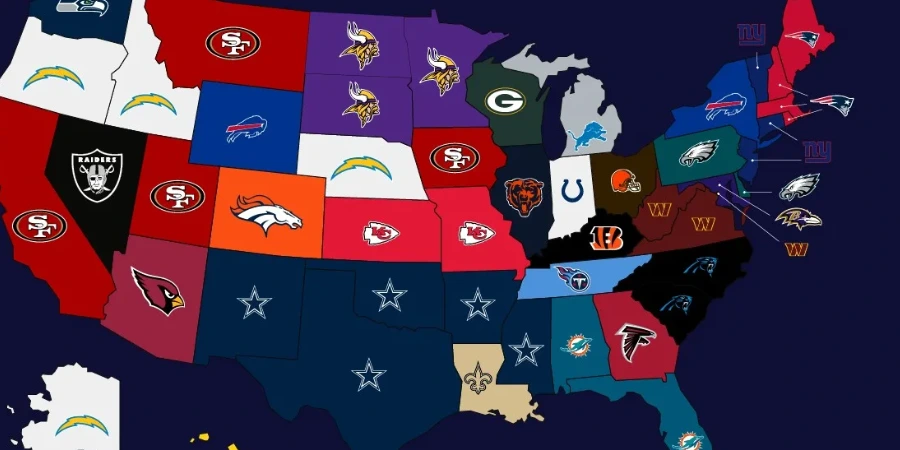
States With One NFL Team
| State | Team | Home Stadium |
|---|---|---|
| Arizona | Cardinals | State Farm Stadium |
| Colorado | Broncos | Empower Field at Mile High |
| Georgia | Falcons | Mercedes-Benz Stadium |
| Illinois | Bears | Soldier Field |
| Indiana | Colts | Lucas Oil Stadium |
| Louisiana | Saints | Caesars Superdome |
| Maryland | Ravens | M&T Bank Stadium |
| Massachusetts | Patriots | Gillette Stadium |
| Michigan | Lions | Ford Field |
| Minnesota | Vikings | U.S. Bank Stadium |
| Missouri | Chiefs | GEHA Field at Arrowhead |
| Nevada | Raiders | Allegiant Stadium |
| North Carolina | Panthers | Bank of America Stadium |
| Tennessee | Titans | Nissan Stadium |
| Washington | Seahawks | Lumen Field |
| Wisconsin | Packers | Lambeau Field |
States With No NFL Team
Several large, economically significant states have no NFL franchise at all:
- Oregon: Portland is a major metro, yet no team. The Portland market overlaps heavily with Seattle, which likely kills expansion interest.
- Connecticut: Wedged between two massive markets (New York and Boston), it effectively has access to multiple teams but claims none.
- Alabama, Mississippi, Arkansas: Deep South college football territory. The SEC commands so much loyalty here that NFL expansion has rarely been seriously discussed.
- Hawaii: Distance and travel logistics make hosting a franchise impractical with current infrastructure.
- Alaska, Montana, Wyoming, Vermont: Population too sparse to support the revenue model the NFL requires.
One commonly misunderstood point: an NFL team needs a metro area of at least several million people, a viable stadium deal, and local ownership that can sustain operations. It’s not just about state population; it’s about concentrated urban markets.
Read Also: Dan Marino Super Bowl Appearances: Record, Career & Legacy
Why Do So Many States Have No NFL Team?
Twenty-eight states don’t host a franchise, and for most of them the reasons are structural rather than cultural. The league applies a quiet set of filters when considering where franchises can survive:
Market size matters enormously
An NFL franchise generates hundreds of millions in revenue annually, with local media deals, corporate sponsorships, and stadium income all dependent on a large, affluent population base. States like Wyoming or Vermont simply can’t generate that scale.
Stadium infrastructure is a prerequisite
Building or renovating an NFL-caliber stadium requires $1–2 billion or more, often requiring significant public subsidy. Without existing infrastructure or political will to fund it, expansion is a non-starter.
Proximity protection
The league quietly protects existing franchises from competition. A team in San Antonio, for instance, would cut into Dallas Cowboys territory, something Cowboys’ ownership has historically resisted.
32 is a ceiling, for now
The NFL has made no public commitment to expansion beyond its current 32-team structure, meaning no new state will gain a team through expansion in the near future without a franchise relocation.
Virginia is the largest-population state without an NFL team, roughly 8.8 million residents, but it sits squeezed between the Washington Commanders and Carolina Panthers markets. That geographic proximity makes standalone franchise viability difficult despite the state’s size.
Why Do Some States Have More Teams Than Others?
Population alone doesn’t determine NFL placement. Several other factors drive it:
Stadium deals: Teams need public or private stadium financing. Cities that offer favorable terms attract franchises. This is why the Raiders moved from Oakland to Las Vegas. Nevada offered a $750 million public subsidy for Allegiant Stadium.
Media market size: The NFL’s TV revenue model depends on market reach. Los Angeles and New York get more attention because their local ratings drive national deals.
Ownership groups: The league approves owners. If a viable ownership group exists in a city, expansion becomes more realistic.
Relocation history: Several current teams moved from other states. The Rams left St. Louis for Los Angeles. The Raiders bounced between Oakland, Los Angeles, and Las Vegas. The Browns technically moved to Baltimore and became the Ravens.
Common Mistakes People Make About NFL Team Locations
Mistake 1: Assuming the team name = the state. The New England Patriots represent six states (all of New England), not just Massachusetts. The Carolina Panthers serve both North and South Carolina.
Mistake 2: Thinking New York teams play in New York. Both the Giants and Jets play in New Jersey. If you’re buying tickets, the stadium is in East Rutherford, NJ.
Mistake 3: Assuming big states = more teams. New York state has two teams but so does Ohio. It’s about metro market density, not geographic size.
Mistake 4: Forgetting Washington D.C. The Commanders play for the nation’s capital but their stadium sits in Maryland. Technically, Maryland hosts two NFL franchises geographically.
Why Team-State Pairings Shift
The current map is also the product of decades of franchise movement. The Raiders alone have been Oakland-based, then Los Angeles, then Oakland again, and now Las Vegas, meaning Nevada only joined the NFL map in 2020.
The Rams’ journey ran from Cleveland to Los Angeles to St. Louis and back to Los Angeles. The Titans were once the Houston Oilers, playing in Texas.
This history matters because the list of what states have NFL teams isn’t static. Franchises follow money, stadium deals, and market opportunity.
The Commanders’ potential return to D.C. proper, if a new stadium gets built inside the District, could shift Maryland back off the multi-team list within this decade.
State Identity and the NFL
There’s something interesting about states where a single team carries the entire state’s identity versus states where rivalries fracture fanbases.
In Louisiana, the Saints are genuinely unifying, the entire state roots as one. In California, you’ll find Rams, Chargers, and 49ers fans in the same household, sometimes with real friction. In Ohio, the Browns vs. Bengals split has cultural weight that goes back generations.
And then there are the states without a team, where adopted fandom fills the gap. Alabama has no NFL franchise but produces more NFL draft picks per capita than almost any state, and its fans tend to scatter toward whichever team signs their favorite college player. It’s a reminder that football culture and official franchise presence don’t always align.
What This Means for Fans Practically
If you’re a fan without a local team, you’re far from alone. Millions of Americans in states like Oregon, Connecticut, Alabama, and others have rooted for out-of-state franchises for decades.
The NFL’s Sunday Ticket package (now on YouTube TV) was built partly for this audience, fans who want to watch their team regardless of where they live.
For sports tourism, states like California, Florida, Texas, and Pennsylvania offer the most options if you want to see multiple teams or stadiums in a single trip. California alone lets you experience three distinct stadium environments within a few hours of driving.
FAQs
Which state has the most NFL teams?
California and Florida each host three NFL franchises, making them tied for the most teams of any state.
Do any NFL teams play in a different state than their city name suggests?
Yes. The New York Giants and Jets play in New Jersey. The Kansas City Chiefs play in Missouri. The New England Patriots play in Massachusetts, but “New England” covers six states.
Has any state ever lost an NFL team permanently?
Missouri lost the Rams (moved to Los Angeles in 2016) and had previously lost the Cardinals (moved to Arizona in 1988). Oakland, California effectively lost the Raiders to Las Vegas in 2020.
Are there NFL teams in U.S. territories?
No. NFL teams are only located in the contiguous United States. There are no franchises in Puerto Rico, Guam, or other U.S. territories, though London and Germany now host regular-season games as part of the NFL’s international series.
Which states are most likely to get an NFL team next?
St. Louis (Missouri), Portland (Oregon), and San Antonio (Texas) are cities most frequently discussed in expansion conversations. A 33rd or 34th franchise would require significant league restructuring, but the NFL has not ruled it out long-term.
Conclusion
The 22 states (plus D.C.) that currently host NFL teams reflect a mix of population density, business strategy, stadium politics, and sports culture. California, Florida, Texas, and Pennsylvania anchor the league geographically, while states like Nevada show how a well-structured stadium deal can bring the NFL anywhere.
Whether you’re a lifelong fan tracking every franchise or a newcomer just figuring out the map, knowing which states have NFL teams and why gives you a sharper lens on how the league actually works.